11 free games that run in your browser. Pick one and start playing.
10x10
CREATED2014
BYGram Games
10x10 is based on 1010!, a mobile puzzle made by Gram Games, a studio in Istanbul, and released in September 2014.
Drag blocks onto a 10 × 10 grid. Fill a whole row or column and it clears away, scoring points and making room. Clear several lines with one piece for a big bonus.You get three pieces at a time and can't rotate them. The game ends when none of them fits, so keep space open for the big 3 × 3 square. Your best score is kept between visits.
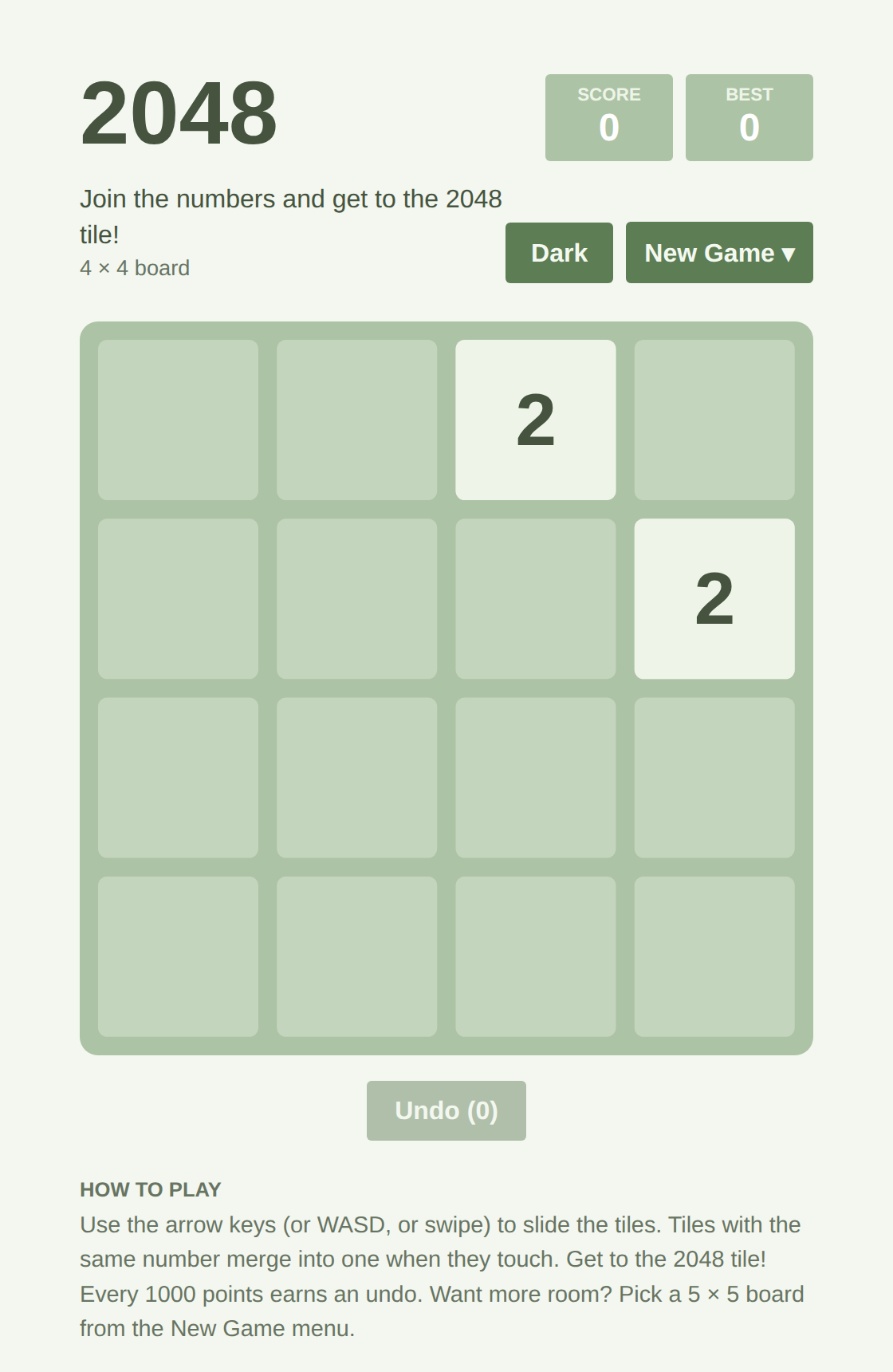
Written over a weekend by the Italian web developer Gabriele Cirulli, and released free on 9 March 2014.
Slide the tiles with the arrow keys, WASD or a swipe. When two tiles with the same number touch, they merge into one worth their sum. Keep merging until you build a 2048 tile.Every move spawns a new 2 or 4 in an empty cell, so the board fills up fast. The game ends when no tiles can move or merge, and your best score is kept between visits.
Created in 1992 by Oleg Demin, Gennady Denisov and Igor Ivkin, and published by Gamos.
The 1992 puzzle classic. Roll coloured balls around a 9x9 board and line up five of a colour, across, down or diagonally, to clear them away.A ball can only roll through empty cells, and every move that doesn't make a line brings three more balls onto the board. Plan ahead, go for long lines for big points, and keep the board from filling up. Your best score is kept between visits.
Patience games were first written about in Germany in the late 1700s. Klondike is thought to take its name from the Klondike Gold Rush of the 1890s, and became the world's best-known solitaire game when Wes Cherry's version shipped with Windows 3.0 in 1990.
The classic patience card game. Build four piles by suit from Ace to King, using seven columns where cards go down in alternating colours.Play Draw 1, or Draw 3 for a tougher game. Drag cards or just tap them, undo as much as you like, and let Finish play out the end. Your game in progress and best times are kept between visits.
Invented in 1970 by Mordecai Meirowitz, an Israeli postmaster and telecommunications expert, and first sold by Invicta Plastics of England in 1971–72. It grew out of an older pencil-and-paper game, Bulls and Cows.
The classic code-breaking game. The computer hides a row of coloured pegs behind a shield, and you have ten guesses to work out exactly what it is.After each guess you get key pegs: black for a right colour in the right hole, white for a right colour in the wrong one. Start with the no-repeats beginner game, play the 1970 original, or take on Super Mastermind's five holes and eight colours. Your fewest guesses for each is kept between visits.
Earlier games such as Mined-Out (1983) for the ZX Spectrum came first, but the best-known version was written by Robert Donner and Curt Johnson for Microsoft and first released in 1990, in the Windows Entertainment Pack.
The classic logic puzzle. Open every square that doesn't hide a mine, using the numbers to work out where the mines must be, and flag them as you find them.Pick Beginner, Intermediate or Expert. Your first click is always safe, and your best time at each level is kept between visits. Works with a mouse or a touch screen.
An ancient game, played since at least the time of the Roman Empire; boards cut into the temple roof at Kurna in Egypt may be far older, though their date is disputed. It was hugely popular in medieval England, and Shakespeare mentions it in A Midsummer Night's Dream.
Place your nine men, then slide them along the lines. Line up three to make a mill and take one of your opponent's men. Leave them with two, or with nowhere to move, to win.Play the computer at three levels, or a friend at the same screen. Down to three men, you can fly anywhere on the board. Your record against the computer is kept between visits.
No one knows who invented it. The first record is from the court of Louis XIV of France: in August 1697 the magazine Mercure galant printed its board, rules and puzzles.
A classic puzzle for one. The board starts full of pegs except for a single hole. Jump a peg over its neighbour into an empty hole, and the peg you jumped is removed.Keep jumping until only one peg is left, ideally in the marked hole. Play the classic English board, the French, J. C. Wiegleb's German board, the diamond or the triangle. Undo is unlimited, and your fewest pegs left on each board is kept between visits.
Two Englishmen, Lewis Waterman and John W. Mollett, each claimed to have invented it in 1883, and each called the other a fraud. Its modern rules were patented in Japan in 1971 by Goro Hasegawa, as Othello.
The classic strategy game, also sold as Othello. Place black and white discs on an 8x8 board, trapping lines of your opponent's discs to turn them over to your colour.Play the computer at three levels, or a friend at the same screen. Fortunes swing wildly right up to the last move, so hold on to the corners and don't count your discs too soon. Your record against the computer is kept between visits.
Howard Garns, a retired architect from Indiana, devised the puzzle, which Dell Magazines published as Number Place in 1979. The Japanese publisher Nikoli took it up in 1984 and named it Sudoku; it spread round the world after The Times of London began printing it in 2004.
The number puzzle. Fill the grid so that every row, every column and every 3×3 box holds the digits 1 to 9 once each, working from the clues you're given.Pick Easy, Medium, Hard or Expert. Every puzzle is freshly made and has exactly one solution. Pencil in notes, undo, or ask for a hint. Your game in progress and your best time at each level (solved without hints) are kept between visits.
Invented by the French mathematician Édouard Lucas and first sold in 1883 under the made-up name "N. Claus (de Siam)", an anagram of "Lucas d'Amiens".
A tower of disks sits on the left rod, largest at the bottom. Move the whole tower to another rod, one disk at a time, without ever putting a disk on top of a smaller one.Every extra disk doubles the challenge: three disks take at least 7 moves, eight take 255. Pick your tower height, undo freely, and try to match the fewest possible moves.